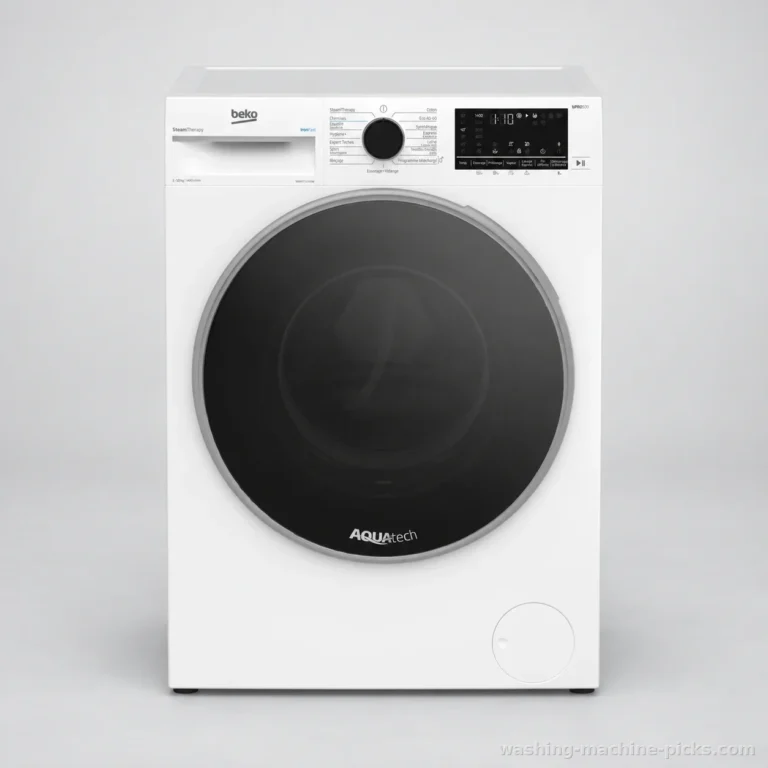
Best connected washing machine 2026, top picks and comparison
Does the Wi-Fi listed in the product specifications really make everyday life easier, or is it just a marketing claim? Our selection of connected washing machines helps you identify models where connectivity offers a real benefit.
Our first product analyses are coming soon.
Why choose a connected washing machine over a conventional model?
A connected washing machine is more than a washing machine with an app added for show. It is a machine that can be controlled remotely from a smartphone, with a digital interface that replaces or complements the physical control panel. Compared with using a conventional control panel, there are 3 differences: the ability to start, monitor and adjust a cycle without being in front of the machine, notifications, and access to programmes that are not built into the original control panel but can be downloaded from the manufacturer's app.
When connectivity makes a real difference
Some uses benefit from connectivity in everyday life. Starting a cycle remotely lets you schedule a wash during off-peak hours without going to the machine, which is useful for anyone keeping an eye on their electricity bill. The end-of-cycle notification helps prevent damp laundry from being forgotten in the drum for several hours, a common problem in homes where the machine is installed away from living areas, in a basement or utility room. Downloading new programmes can also keep a machine relevant as fabrics or needs change, without having to replace the appliance. Finally, remote diagnostics available through some apps help identify a fault before a technician visits, which can speed up a repair.
What connectivity does not change
Keep a simple rule in mind: connectivity controls the machine; it does not make it wash better. Spin performance, load capacity and energy consumption depend on the motor, drum and tub insulation, rather than the app. A high-end connected washing machine with the wrong capacity for the household will still be less practical day to day than a well-chosen conventional washing machine. Never confuse connectivity with washing performance: these are 2 independent criteria to assess separately before buying.
Who really benefits from connectivity
Connectivity makes particular sense for households with irregular schedules, who use off-peak electricity late at night or early in the morning, as well as for people working from home who can monitor a cycle without constantly thinking about it. It is also useful when the machine is away from living areas, in a basement or storage room, where the end-of-cycle signal may not always be heard. Conversely, in a household where the machine is right next to the kitchen or living room, or is used only occasionally, these features offer limited extra convenience and do not necessarily justify a higher cost.
The market segment directly influences the connected features available: entry-level models often offer only basic notifications, while mid-range and high-end models add remote diagnostics, voice assistant compatibility and downloads of additional programmes. To help you identify the model that actually suits your needs beyond the marketing claims, the selection below details the available ecosystems and the technical features that make a difference day to day.
How to choose your connected washing machine
Choosing a washing machine with smart connectivity involves more than checking the Wi-Fi box on the product specifications. Connectivity changes some everyday routines, but it never replaces the mechanical criteria that determine washing quality. Here are the points that should guide your choice.
Which app and ecosystem suit your smart home
Before settling on a model, check that its ecosystem works with the rest of your smart home. Compatibility with Alexa, Google Home or the Matter protocol determines whether you can create automations (starting a cycle by voice command or including it in a smart home routine). A Matter-compatible washing machine reduces dependence on a single proprietary app.
Which connected features are useful and which are gimmicks
3 uses stand out as practical in everyday life:
- Starting a cycle remotely to take advantage of off-peak hours without being at the machine
- Receiving an end-of-cycle notification on your phone, useful when the washing machine is far from your living areas
- Downloading new programmes or running remote diagnostics if a fault occurs
Conversely, some features highlighted in product specifications (detailed consumption statistics, automatic programme suggestions) are rarely used after the first few weeks. Avoid paying extra for options you will never enable.
The conventional criteria you should still consider when choosing a connected model
Connecting to an app does not change the machine's mechanics. The capacity in kg should still suit your household size, the spin speed affects the drying time needed afterwards, and the energy efficiency class affects your bills over several years. The noise level deserves particular attention if the machine is installed near a living area or bedroom. A highly connected model that falls short in these areas will still disappoint.
What budget to allow for each product tier
Connected models span every tier, from entry-level to high-end. Price differences generally reflect motor quality, sound insulation, automatic load detection or a reinforced drum. A washing machine with an induction motor is often found in the mid-range and high-end tiers, with manufacturers claiming greater durability. By contrast, a budget washing machine may offer a basic app while remaining limited in spin performance or sound insulation: connectivity alone never makes up for an entry-level motor.
What to check before buying a connected washing machine for your smart home
Before buying, check 3 things: Matter compatibility for the future of your setup, working integration with Alexa or Google Home if you already use them, and the manufacturer's update policy. An app abandoned after a few years turns a connected washing machine into an ordinary washing machine, which should factor into your decision.
| Criterion | What to look for | Common mistake |
|---|---|---|
| Ecosystem and app | Matter, Alexa or Google Home compatibility to suit your setup | Choosing without checking whether the app works with the rest of your home |
| Connected features | End-of-cycle notifications, remote diagnostics, downloadable programmes | Paying extra for statistics you never check |
| Capacity and spin performance | Capacity suited to your household, sufficient spin speed | Focusing on the app while overlooking capacity in kg |
| Noise level | Sound insulation suited to the intended location | Installing near a bedroom without checking the noise level |
| Long-term support | The manufacturer's update history for previous models | Ignoring the risk of the app being abandoned after a few years |
Mistakes to avoid
- Choosing a model solely for its app without checking capacity, spin performance or noise level
- Forgetting that connectivity depends entirely on your home Wi-Fi: an outage or poor coverage is enough to make remote features unusable
- Failing to anticipate that a user account and the collection of certain data are generally required to use connected features
- Comparing models solely by the number of downloadable programmes without considering the quality of the motor or drum
- Overlooking Matter compatibility in favour of a closed proprietary ecosystem, potentially limiting future smart home upgrades
Key takeaways
Choose a connected washing machine as a washing machine first and a connected device second. The most useful remote features are just a handful: end-of-cycle notifications, remote diagnostics, programme downloads and off-peak scheduling. The rest is often marketing. Check compatibility with your smart home ecosystem, never sacrifice capacity, spin performance or noise level for connectivity, and remember that the app's long-term availability depends entirely on the manufacturer.
Questions to ask before buying a connected washing machine
Does a connected washing machine use more electricity than a conventional model?
No, connectivity itself uses no significant amount of electricity. The energy efficiency rating depends on the motor, insulation and washing technology, not the built-in Wi-Fi. However, the app can help schedule cycles during off-peak hours, reducing bills without changing the machine's actual energy consumption.
Do you need an account and an app to use a connected washing machine?
No, the machine can still be used normally from its control panel. Without an account, you lose these features but the washing machine's basic functions remain available.
What happens if your home Wi-Fi stops working?
The machine continues to operate independently with its installed programmes; only remote control and notifications become unavailable. This is a limitation to bear in mind: a connected washing machine still depends on the quality of your home network, particularly if it is installed in a basement or a utility room far from the router.
Is a connected washing machine more fragile or less reliable than a conventional model?
The connectivity module adds an extra electronic component, but it does not affect the mechanics of the drum, motor or drain pump. User feedback mainly highlights a different concern: continued app updates over time, rather than the machine's mechanical reliability.
What is the difference between a connected washing machine and an intelligent washing machine?
A connected washing machine can be controlled and monitored remotely through an app, but follows the settings chosen by the user. An intelligent washing machine goes further by using internal sensors to automatically adjust certain settings through features such as load detection or detergent dosing. Connectivity therefore enables communication, while built-in intelligence enables automation.
Does a connected washing machine work with Alexa or Google Home?
It depends on the model and the manufacturer's ecosystem. Some ranges offer Alexa compatibility or Google Home support to start a cycle or receive a voice notification, while others remain limited to their proprietary app. Support for the Matter protocol is becoming more widespread, making integration into a connected home with devices from multiple brands easier.
How long will the manufacturer keep updating a washing machine's app?
There is no standard guaranteed support period across the market, and this is one of the least documented aspects at the time of purchase. Manufacturers do not always state their software support commitments, creating a risk that the app will gradually be abandoned after a few years, even while the machine continues to work.
Is connectivity worth paying extra for compared with a conventional washing machine?
It mainly depends on how you actually use it. If you regularly run cycles during off-peak hours or need end-of-cycle notifications, the extra cost is easy to justify. For conventional use without off-peak scheduling, it is better to spend your budget on an affordable washing machine that performs well than on connected features you rarely use day to day.