Best washing machine with an anti-allergen program 2026, top picks and comparison
Compare the allergens targeted and the suitable fabrics to choose your washing machine with an anti-allergy programme. Use the filters to narrow your search based on your laundry care needs.
Prices collected from retailers are for guidance only: they may have changed since, the current price is the one shown by the retailer. No price is shown for models sold only on Amazon. Amounts converted from reference prices in euros using a dated exchange rate.
Why these models are listed here
- 1 model selected because they have the feature “Anti-allergen program” according to data published by manufacturers and retailers.
- See how we rate →
- No brand pays to be included in this selection or to rank higher.
Why choose a washing machine with an anti-allergy programme?
Why look for a dedicated allergen programme
The best washing machine with an anti-allergen programme is the one whose cycle suits your laundry and the allergens you want to reduce. The aim is to have a programme with clearly documented objectives, without assuming it is effective based on its name alone. No appliance guarantees that allergy symptoms will disappear.
This category may interest you if you want to adapt how you care for sheets, pillowcases or clothes regularly exposed to pollen. It is also worth considering if dust mites in your surroundings are a concern. However, check that the programme targets the relevant allergens and is suitable for the fabrics you intend to wash.
The intended benefit is practical: organising laundry care around a specific need. To decide whether this function will be useful, start with the items you wash regularly, then examine the cycle conditions.
- For bedding, check that the fabrics are compatible with the programme.
- For clothes exposed to pollen, look for documentation that mentions this allergen.
- For needs related to an identified allergy, use your healthcare professional's recommendations as a guide.
Anti-allergen and hygiene claims are not interchangeable
An anti-allergen programme, a hygiene programme and a crease-reduction function do not necessarily serve the same purpose. Reducing allergens, targeting bacteria and reducing creases are different actions. A claim about any of these does not establish anything about the others.
The word steam is not proof of anti-allergen effectiveness. If you compare this category with a washing machine with a steam function, look at precisely what each programme claims to do. The presence of steam alone does not establish which substances are targeted, which fabrics are compatible or which conditions are needed to achieve the stated result.
When choosing a washing machine for people with allergies, prioritise a clear explanation of the programme. Any certification should also be read with its exact scope in mind. It does not allow a conclusion to be extended to all allergens, all cycles or all loads.
Detergent residue is a separate issue
Allergens in laundry and substances from laundry detergents are different issues. Discomfort when wearing a garment does not, on its own, identify the cause. Choosing an anti-allergy washing machine therefore does not remove the need to consider the products used and their dosage.
The detergent dosage and rinsing deserve particular attention. Follow the detergent and washing machine instructions, taking the load into account. Where an extra rinse is available, check its conditions of use: this option does not guarantee tolerance for everyone and does not replace choosing a suitable detergent.
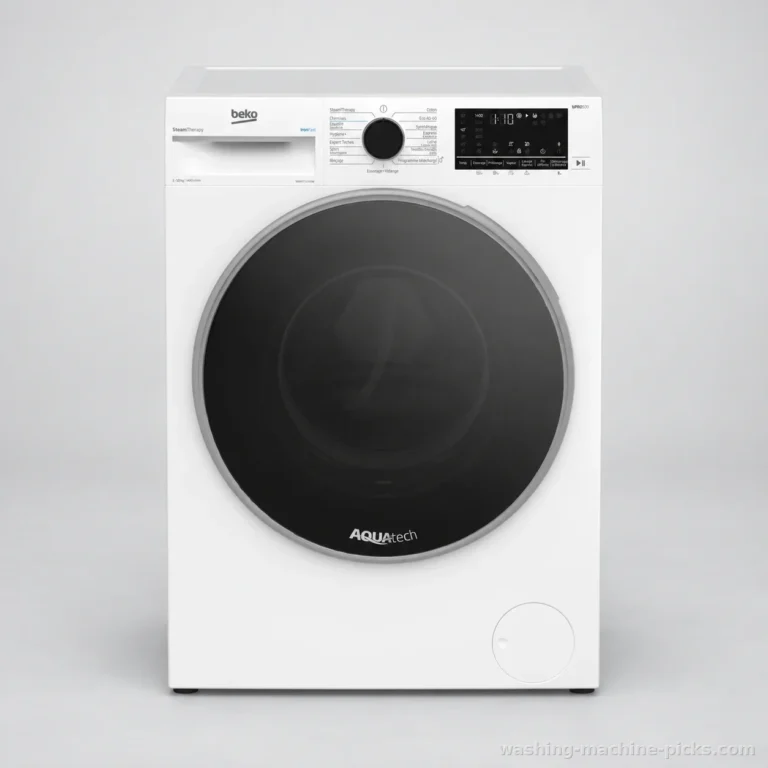
To continue narrowing down your choice, consult the selection on this page with these distinctions in mind. The LG F14R50WHS is the model to examine in this collection; its inclusion alone does not make it the best on the market. Base your decision on documented functions and how well they suit your laundry.
How do you choose a washing machine with an anti-allergy programme?
To choose the best washing machine with an anti-allergen programme, prioritise the cycle documentation over its marketing name. Check which allergens it targets, which fabrics it accepts and the permitted load. Then compare the programme's restrictions with your actual needs. An appealing feature offers little value if it is unsuitable for the laundry you want to treat.
What evidence should you check before choosing a model
Start by consulting the manual and the official programme description. Look for the manufacturer's specific claims and the conditions under which they apply. The terms “hygiene”, “steam” and “anti-allergen” alone do not establish equivalent effectiveness.
A washing machine with a steam function therefore warrants the same checks. If a certification is highlighted, check the issuing body, its scope and the programme it covers. Recognition for a specific cycle does not necessarily apply to every wash.
The LG F14R50WHS is included in this collection. However, whether it has an anti-allergen programme, that programme's features, operating conditions and certifications still need to be verified. We therefore cannot call it the best on the market or attribute any particular effectiveness to it.
What load and fabrics does the programme accept
The overall drum capacity is not enough to make a decision. Look for the maximum load for the programme you are interested in. Compare it with the amount of laundry you actually need to wash, particularly sheets, clothing or towels.
Then check the permitted fabrics and temperature instructions. Your items' care labels must be compatible with the cycle conditions. A programme designed for certain fabrics does not become suitable for your entire wardrobe simply because it carries a reassuring label.
- Identify the laundry you want to treat regularly.
- Check the programme restrictions for each fabric category.
- Assess whether the permitted load will mean running more washes.
A large overall capacity does not make up for a dedicated cycle that is too restrictive for your household.
How to compare the restrictions of the dedicated cycle
Look for the anti-allergen programme's duration, water consumption and electricity consumption. The figures for the reference programme on the energy label cannot be used to infer those of this particular cycle. When this information is missing, treat it as unknown.
For the LG F14R50WHS, the duration, permitted load and consumption figures for the relevant cycle remain unconfirmed. These points need to be clarified before choosing this model for regular use.
Rinsing also deserves your attention. If you are concerned about detergent residue, check the extra rinse options and follow the dosage instructions. Reducing allergens and removing detergent residue are distinct objectives.
| Criterion | What to look for | Common mistake |
|---|---|---|
| Anti-allergen claim | A specific objective and documented conditions | Relying solely on the programme name |
| Load and fabrics | A cycle suitable for your everyday laundry | Focusing only on drum capacity |
| Duration and consumption | Information specific to the dedicated cycle | Extrapolating from the energy label |
| Rinsing | Options suited to your needs | Confusing allergens with detergent residue |
| Installation and maintenance | An accessible appliance that is easy to maintain | Overlooking your home's constraints |
Which market segment suits your priorities
Compare entry-level, mid-range and high-end models based on their documented features. A higher market position is no proof of allergen reduction effectiveness. Your priority remains a programme that suits the fabrics concerned and is sufficiently documented.
Then rank features by how useful they are to you. A connected washing machine may interest you for its monitoring features, where these are specified. This does not justify prioritising it if the conditions of the programme you need remain unclear. Without verifiable market data, no reliable budget range can be suggested.
Which criteria distinguish suitable appliances
Once the programme requirements are met, measure the available space and the clearance needed for loading. For a freestanding washing machine, also check the clearances required by the manual and access to the connections.
Compare documented noise levels with the intended location in mind. Also examine access to parts that need maintenance, spare parts availability, repair options and warranty terms. These criteria can help distinguish appliances whose programmes meet your needs equally well.
Mistakes to avoid
- Automatically equating steam, hygiene and allergen reduction.
- Choosing based on overall capacity without checking the dedicated cycle's capacity.
- Assuming a programme is suitable for all fabrics.
- Treating missing information as a confirmed feature.
- Expecting an appliance to guarantee that symptoms will disappear.
Key points to remember
Choose an appliance whose programme is documented and suitable for your laundry. Before buying, check the allergens targeted, load capacity, fabric types, cycle duration and energy and water consumption. Then compare models based on installation, maintenance and repairability. If a key detail is missing, ask for confirmation before choosing.
What should you clarify before choosing your washing machine?
Can you use an anti-allergen programme for every wash?
Yes, provided the fabrics and load meet the conditions specified in the programme instructions. This cycle may not be suitable for all your laundry, especially items whose care labels require gentle washing. Check which fabrics are suitable and the cycle requirements before making it your default choice. The best washing machine with an anti-allergen programme is one whose programme meets your actual needs, without guaranteeing that symptoms will disappear.
Should an allergic person’s laundry be washed separately?
Not necessarily, as washing separately mainly depends on the allergen involved and individual medical advice. It may be appropriate when certain clothes have been heavily exposed, but it cannot guarantee allergen-free laundry. Above all, follow the programme instructions and fabric care labels. If reactions persist, seek advice from a healthcare professional to distinguish an allergy from irritation caused by laundry products.
Does an anti-allergen programme replace washing machine cleaning?
No, an anti-allergen programme does not replace washing machine maintenance. Treating laundry and cleaning the appliance serve different purposes. Follow the manual to maintain the detergent drawer, seals and accessible parts, and to run a cleaning cycle if applicable. Do not assume that a washing machine with a steam function automatically performs this maintenance or has documented anti-allergen effectiveness.
What should you do if laundry still smells after washing?
Start by checking how the laundry is dried, the detergent dosage and the appliance’s maintenance. A lingering smell proves neither the presence of allergens nor that the programme is ineffective. Avoid leaving damp laundry in the drum and observe the load limit for the selected cycle. If the problem recurs, consult the manual’s recommendations before changing the programme or adding a fragranced product that could cause a reaction.
Can drying laundry lead to renewed pollen exposure?
Yes, laundry dried outdoors can be exposed again to airborne pollen. If you are sensitive to it, choose where to dry your laundry according to local pollen conditions and, where possible, use a suitable, ventilated indoor space. The anti-allergen programme does not protect fabrics from exposure after washing. Wait until laundry is completely dry before folding it and putting it away.
How should you store clean laundry to limit renewed allergen exposure?
Store completely dry laundry in a clean, closed cupboard to limit its exposure to dust and airborne particles. Avoid placing it on a surface with worn clothes or fabrics exposed to pollen. Clean storage spaces regularly without using too many fragranced products. These precautions complement washing, but cannot guarantee that fabrics will be completely free of allergens.